
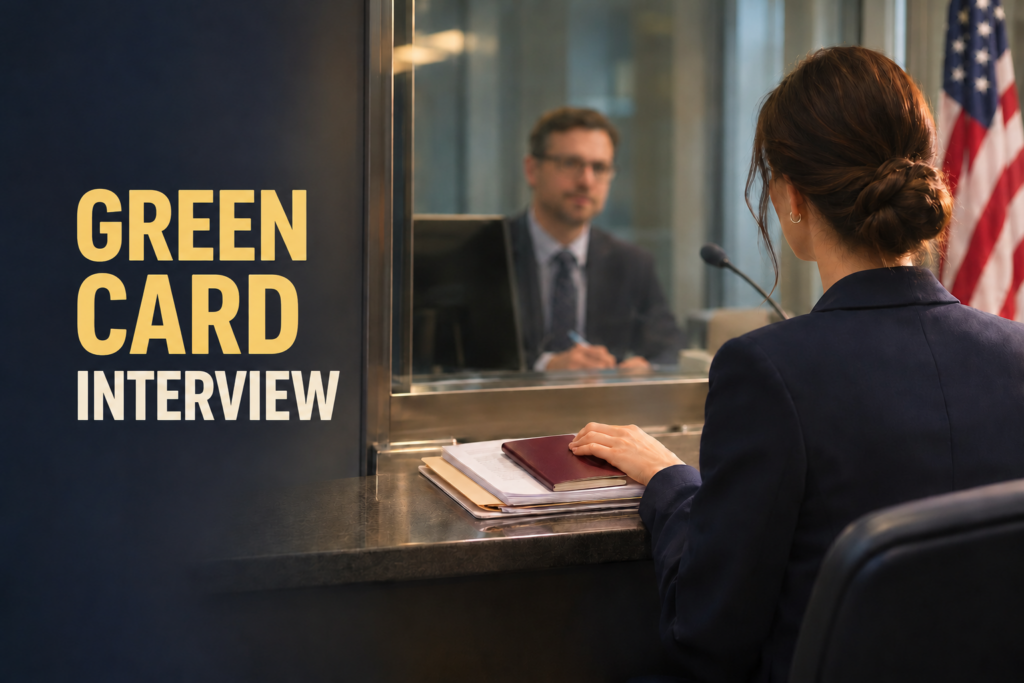
You may have waited years to get to this point. USCIS has approved your petition, and you may finally have a green card interview scheduled at a U.S. embassy or consulate. An approved petition gets you to the next stage. The consular officer still decides whether you qualify for an immigrant visa. Missing documents, significant inconsistencies, or unanswered questions about financial support can delay your case or lead to a visa refusal. U.S. Department of State guidance on immigrant visa interviews
A straightforward case can have a brief interview, which is why this appointment is sometimes described as a formality. In February 2026, the State Department highlighted applicants’ ability to cover living expenses and potential medical costs as part of its visa screening guidance. If years have passed since your petition was filed, take time to check whether your documents, financial support, and plans for moving to the United States reflect your circumstances today. State Department guidance on public benefits reliance
What does I-130 or I-140 approval mean?
Petition approval is the first major milestone in these family-based and employment-based green card cases. For applicants using consular processing, it establishes the basis for applying for an immigrant visa through a U.S. embassy or consulate abroad.
| Petition | Who files it | What USCIS approval establishes |
|---|---|---|
| Form I-130, Petition for Alien Relative | A U.S. citizen or lawful permanent resident files for an eligible family member. This includes many marriage-based green card cases. | USCIS found that the evidence established a qualifying family relationship for the category requested. |
| Form I-140, Immigrant Petition for Alien Workers | A U.S. employer files in many employment-based categories. Eligible applicants may self-petition in certain categories, including EB-1A and EB-2 National Interest Waiver (NIW). | USCIS found that the petition met the requirements for the requested employment-based immigrant classification. |
USCIS Form I-130 instructions · USCIS Form I-140 instructions
If your case is in a numerically limited family- or employment-based preference category, your priority date and the State Department’s Visa Bulletin help determine when a visa number is available. Immediate relatives of U.S. citizens, including spouses, unmarried children under 21, and parents of U.S. citizens who are at least 21, are exempt from these numerical limits. They still need to complete visa processing and wait for an interview appointment. State Department Visa Bulletin · National Visa Center guidance
What happens after I-130 or I-140 approval?
- National Visa Center (NVC) processing. In a typical consular case, USCIS sends the approved petition to the NVC. You pay the required fees, complete Form DS-260, and submit the required civil and financial documents. State Department guidance on NVC processing
- Interview scheduling and medical exam. Once your case is documentarily complete, the NVC can schedule an interview when an appointment and, where applicable, a visa number are available. Follow your embassy or consulate’s instructions to complete your medical exam with an approved physician and gather the documents you must bring. State Department interview preparation instructions
- Consular decision. The officer determines whether you qualify for an immigrant visa. The officer may approve the application or refuse it, including under section 221(g) when documents are missing or further administrative processing is necessary. If a visa is issued, you become a lawful permanent resident when you are admitted to the United States on that immigrant visa. State Department guidance on what happens after the interview
What questions can you expect at a green card interview?
In a family-based green card interview, the officer may ask about your relationship with the petitioner and your plans after moving to the United States. In a marriage-based case, be ready to explain how you met, describe your life together, and say where you plan to live. Depending on your circumstances, you may also need to explain how you will support yourself during the first few months.
- Where will you live, and who will live with you?
- How will you cover rent and everyday expenses before you start earning income?
- Who will help support you financially, and what documents show that support?
- What work do you plan to pursue, and what experience or qualifications do you have?
- How do you plan to obtain health insurance or cover potential medical expenses?
If you plan to live with relatives while looking for a job, be ready to say where you will stay, who will pay for which expenses, and what funds are available. If a job or insurance coverage is still in the planning stage, say so. Read more about green card financial requirements and the questions a consular officer may ask.
For an employment-based immigrant visa interview, be prepared to discuss the job title, duties, work location, and whether the offer is still available if your case is based on a job offer. Some consulates ask for a recent employer letter. If the employer, role, or professional plans described in your petition have changed, speak with an immigration attorney before the appointment. U.S. Embassy Warsaw interview instructions
How do public charge and Form I-864 affect a green card interview?
The public charge ground of inadmissibility, under section 212(a)(4) of the Immigration and Nationality Act (INA), concerns whether an applicant is likely to become primarily dependent on the U.S. government for subsistence. Consular officers consider factors such as age, health, family circumstances, financial resources, education, and skills. If medical expenses are relevant to your case, be ready to explain how you plan to pay for care or obtain coverage. A private health insurance policy in place on interview day is not a universal requirement for an immigrant visa. Foreign Affairs Manual guidance on public charge · State Department guidance on consular screening
In most family-based cases, the petitioning sponsor submits Form I-864, Affidavit of Support, a legally enforceable commitment to provide financial support. If the sponsor’s income is insufficient, a qualifying joint sponsor may be an option. When Form I-864 is required, the petitioning sponsor still submits their own form even if a joint sponsor files a separate one. The officer reviews the affidavit alongside the rest of the case. Most employment-based applicants do not need Form I-864, although the public charge assessment may still apply. State Department Form I-864 FAQs · State Department guidance on visa refusals
What if your immigrant visa is refused after the interview?
Start with the legal ground listed in the refusal notice. It determines whether you can provide documents, request reconsideration based on new evidence, seek a waiver, or submit a new application.
| Ground for refusal | What may happen next |
|---|---|
| INA 221(g) — Missing documents or information | Follow the consulate’s instructions for submitting what it requested. The State Department generally gives applicants one year from the refusal date to submit the requested information. The officer can then reassess the application. |
| INA 221(g) — Administrative processing | The consulate conducts further review. Follow its instructions if it requests documents or clarification. |
| INA 212(a)(4) — Public charge | Depending on the reason for refusal, additional financial evidence, a corrected Affidavit of Support, or documents from a qualifying joint sponsor may address the issue. |
| Another ground of inadmissibility | Options depend on the legal ground and your circumstances. Some grounds have a waiver process. A new application by itself does not resolve an existing ground of inadmissibility. |
There is generally no ordinary appeal from a consular immigrant visa refusal. Under 22 CFR § 42.81(e), the case must be reconsidered if, within one year of the refusal, you present further evidence tending to overcome the stated ground of ineligibility. In some cases you can apply again. Before doing so, confirm whether the original petition can still be used and what has changed since the refusal. State Department guidance on visa refusals · 22 CFR § 42.81
In August 2026, the State Department announced a Public Charge Bond pilot. In selected cases, a consular officer may direct an applicant refused under INA 212(a)(4) to apply for a bond with USCIS. The consulate notifies applicants selected for this process. State Department Public Charge Bond announcement
How to prepare for your green card interview
- Review your DS-260 and prior filings. Check dates, addresses, employment history, and previous stays in the United States. Identify any changes or errors and confirm how to report them.
- Use your consulate’s document checklist. Gather your passport, interview notice, DS-260 confirmation page, and required originals, certified copies, or translations. State Department embassy and consulate instructions
- Update financial records. If your sponsor changed jobs or their income changed, check whether you need current income evidence or joint sponsor documents.
- Make a plan for your first few months in the United States. Be able to explain where you will live, how you will pay your bills, and how you would handle medical costs.
- Practice answering questions about your own case. Use your own words and stick to the facts. If you have a prior visa refusal, an overstay, or another immigration issue, discuss it with an attorney before the interview.
Can my attorney attend my immigrant visa interview with me?
Check the instructions for the embassy or consulate handling your case. The U.S. Embassy in Warsaw, for example, does not allow attorneys to accompany clients into the waiting room or to the interview. You can review your documents and practice case-specific questions with an attorney ahead of the appointment. U.S. Embassy Warsaw rules on accompanying persons
Have an interview date? Prepare with immigration attorney Ilona Szymkowicz
If you’ve waited years for your interview, use the time before your appointment to review your application and address any changes. In a consultation with immigration attorney Ilona R. Szymkowicz, you can go over your DS-260, your sponsor’s documents, your plans for supporting yourself in the United States, and questions that may come up because of your immigration history. You can also discuss what to update or bring to the appointment.
Book a green card interview preparation consultation
